

Looking for Connection: What a Community Platform Needs to Grow with Us Throughout Our Lives
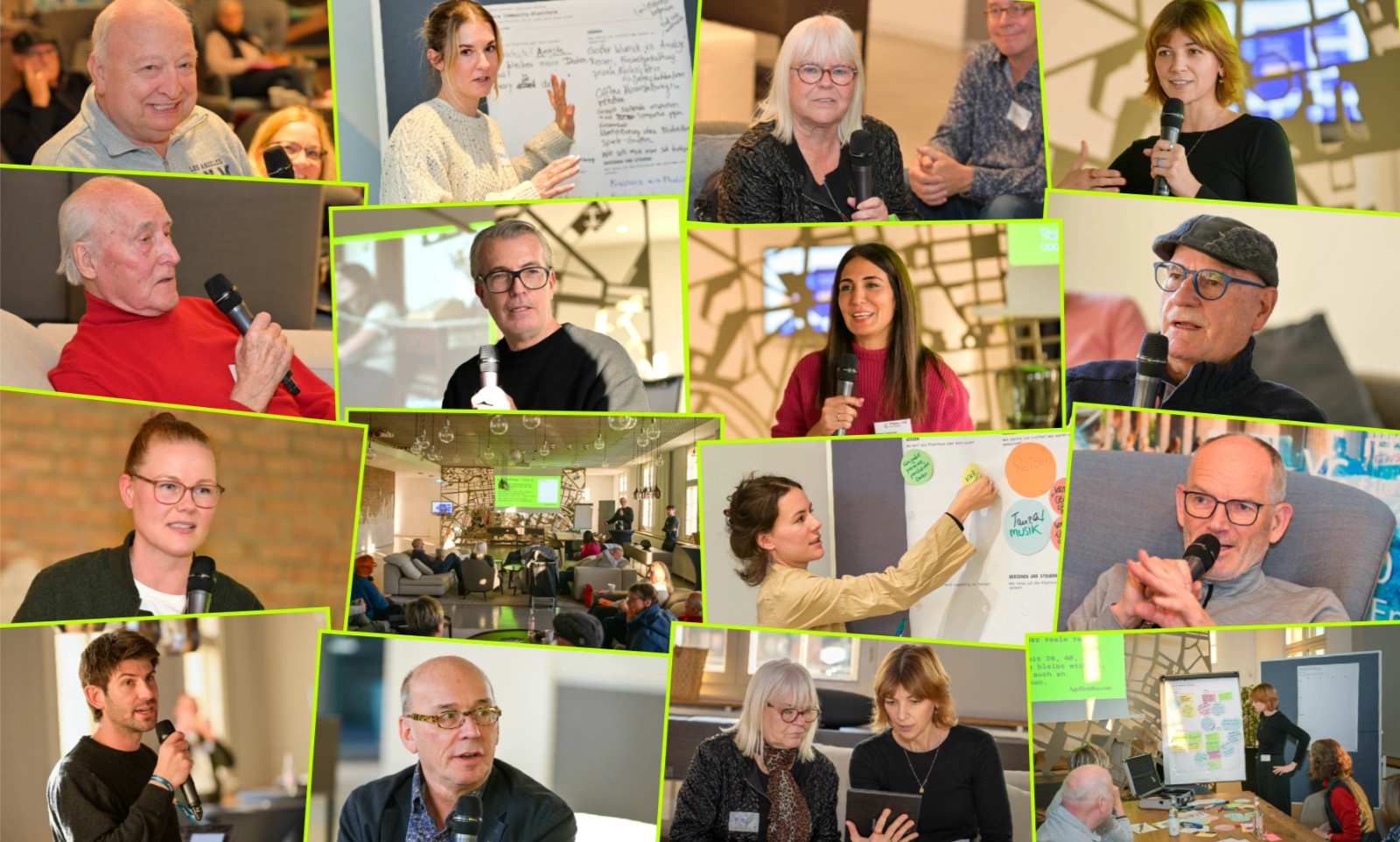
We need connection throughout our lives. But our interests, relationships, and expectations change. Does that mean signing up again, finding our way around, and learning yet another platform? In our second Age Forward Lab Sprint, we asked: What would it take to build a community platform that brings our different communities together and evolves with our lives?
One Life. Many Logins.
Keeping up with friends, sharing experiences, meeting people, or doing something together. We use different platforms for all of it, often several at once. Some connections stay with us for decades. Others grow out of a new role, a shared interest, or getting to know the people in our neighborhood.
As our lives change, so does the way we want to take part. Sometimes we want to help shape things. Sometimes we just want to follow along. We look for fresh perspectives, want to share what we know, or hope to find someone to share an experience with. Digital platforms should give us room for all of that.
In our second Age Forward Lab Sprint, “Looking for Connection,” we asked: What do you expect from a community platform? What are you comfortable letting it know about you? What do you want to control yourself? And how would it need to evolve to fit your life at different stages?
At the heart of this is a question central to Age Bombs: How do we design technology that can grow with us as our lives change? For communities, that also means giving people control over the connections they maintain, what they contribute, and how close they want to get. Making contact can be easy. Feeling a sense of belonging takes more.
A Platform That Grows with Us
In the second Age Forward Lab Sprint, three groups developed ideas for a community platform that supports people through different life circumstances and helps them connect. They explored four dimensions: Knowledge, Capabilities, Belonging, and Usability & Control. The groups then considered how their ideas might hold up over a lifetime: Which needs stay the same? Which change? And which have more to do with someone’s circumstances than their age?
The following analysis brings together the six worksheets and the three groups’ final presentations. It explores the needs, design principles, and tensions behind the features they proposed.
The Big Picture Across All Three Groups
Across all three groups, a strikingly consistent vision emerges: a platform that prioritizes interests and activities over age. What brings people together is what they share, what they want to learn from one another, or what they want to do together, rather than belonging to the same age group.
At the same time, the platform should offer more than digital communication. All three groups explored how an online connection could lead to meeting in person, showing up for one another, and building lasting relationships. They saw the digital space as a way to help people take part in community life, rather than an end in itself.
This connects well with the Convoy Model of Social Relations. The model describes how people move through life with a changing “social convoy” of relationships, varying in closeness. Some people remain part of that convoy for years; others join or become less central. As life circumstances change, so do the roles relationships play. This same dynamic emerged in the group work: the platform should help people make new connections while also keeping existing relationships alive through life changes or making it easier to reconnect.
A second theme across the groups is a tension: the better the platform understands people, their interests, and their circumstances, the more relevant the connections it can suggest. At the same time, people want privacy, control, and a choice about what they share. Personalization should be an option, with people firmly in control.
Findings Across All Three Groups in Four Dimensions
Knowledge
The platform can draw on people’s interests, needs, and some details about their life circumstances to suggest relevant groups, people, and activities. At the same time, the groups strongly emphasized privacy, control over what information they share, and keeping required personal details to a minimum. Profiles should be easy to update as life changes, rather than leaving people defined by an earlier stage of their lives.
Capabilities
Finding like-minded people, sharing knowledge and experiences, offering mutual support and advice, and doing things together are central. The platform should help people discover existing groups and start new ones. A key priority is connecting online interaction with in-person experiences: meetups, trips, sports, cultural events, volunteering, or spontaneous plans.
Belonging
Matching alone doesn’t create a sense of belonging. Trust, authenticity, respect, appreciation, personal rapport, commitment, and getting something meaningful out of taking part came up repeatedly. Community guidelines, moderation, and protection against hate speech, harassment, and fake profiles should help create safe spaces to connect. People should also be free to choose how close they want to get, with open and private groups, lasting relationships, and spontaneous connections all having a place.
Usability & Control
The groups wanted a platform that feels approachable, is intuitive to use, and makes getting started easy, with support along the way. Users should be able to control notifications, data sharing, filters, and how they communicate. Other suggestions included automatic translation, different media formats, and ways to take part that welcome people with less digital experience.
Knowledge: Personalization takes trust
The Knowledge dimension brings a central tension in digital communities into focus. The platform needs to know enough about its users to suggest relevant people, groups, and activities. Group 3, for example, explored interest-based profiles and AI-powered recommendations. At the same time, they explicitly cautioned against turning this into extensive data collection.
Group 1 emphasized that people need granular, context-sensitive control over what they share: What information do I share, when, with whom, and how much? Group 2 made the tension especially clear: a platform should adapt to different stages of life while allowing people to share as little about themselves as possible when they first join.
This points to a key design principle:
The more value people see in the platform and the more they trust it, the more willing they are to share information.
Trust also depends on authenticity. Alongside privacy, several groups discussed verification, protection against fake profiles, and ways for community members to help maintain standards.
Capabilities: Digital connections should open up possibilities in everyday life
In the Capabilities dimension, the focus was on doing things together, with less emphasis on conventional social media use. The groups wanted platforms where people could discover interests, share knowledge, learn from one another, get advice, and organize activities together.
The range was deliberately broad: travel, hiking, sports, cooking, music, education, volunteering, games, and marketplaces. Group 3 took this idea furthest, envisioning a platform “for everyone”, where users could build on existing interest groups by creating new communities, including ones focused on very specific interests.
The strong focus on meeting in person stands out. Group 2 even described their “big wish: taking it offline.” Ideally, an online group for Doppelkopf, travel, or hiking would lead to people actually getting together.
From the perspective of aging psychology, this matters because social participation involves more than simply being in contact. It includes shared activities, exchange, and the experience of actively taking part in social life. Research suggests that greater social participation may be associated with better cognitive health. Proposed mechanisms include social and cognitive stimulation, reduced stress and depression, and the development of cognitive reserve. This shifts the central design question from:
“How do we keep people on a platform for as long as possible?”
to:
“What does the platform help people do beyond the platform itself?”
Belonging: Shared interests aren’t enough
The findings in the Belonging dimension connect directly to the workshop’s psychology presentation. None of the groups considered matching and contact alone enough.
People want to meet others who share their interests, people they like and trust, and who treat them with respect. Group 3 explicitly highlighted appreciation, respect, and meeting as equals. Group 1 added authenticity and commitment: if someone signs up for an activity, for example, they should actually show up.
Another interesting point is that belonging can come in different degrees of closeness. Group 1 distinguished between open and private groups. Group 2 discussed whether people might want to keep meeting the same people or get together spontaneously with someone new. Both were seen as valid.
Socioemotional selectivity theory offers a useful perspective here. It suggests that people may prioritize different social goals depending on how much time they feel lies ahead. When the future feels open-ended, exploration, new experiences, and new connections may take priority. When time feels more limited, emotionally meaningful and familiar relationships become more important. What matters is a person’s subjective sense of time, rather than chronological age alone.
For digital communities, this means people seek different kinds of connection at different times. Sometimes they want to meet new people, find inspiration, and explore. At other times, they place more value on reliability, depth, and familiar relationships.
A good community gives people room to work out how close they want to be, what commitments they want to make, and how long those connections last, rather than trying to maximize attachment.
Usability & control: Choice over one-size-fits-all
Across all groups, the Usability & Control dimension brought a clear call for easy access. Getting started should be simple, navigation intuitive, and language clear, with support available when needed, so that using the technology doesn’t become a barrier to taking part.
The groups called for different ways of using the platform to coexist, rather than a simplified “senior interface” for particular age groups.
Group 1’s discussion about communication offers a good example: some users expect and welcome real-time interaction, while others find the pressure to respond all the time stressful. Similar differences arise around push notifications, online and offline ways to take part, and age filters.
Group 3, for example, actively debated the pros and cons of an age filter. They settled on an optional feature: people could choose to find others in a particular age group for a specific activity, while the platform itself would avoid sorting people by age as a default.
The lifespan perspective: Age doesn’t tell the whole story
The second worksheet made it especially clear that the groups struggled to assign needs neatly to the given ages of 20, 40, 60, and 80. Some explicitly rejected the idea.
This may be one of the workshop’s most important findings, rather than a problem with the method.
Group 2 explicitly questioned the conventional sequence of “education, work and family, retirement.” Parenthood, career changes, fresh starts, travel, caregiving, and new interests can happen at very different points in life. Their conclusion: The starting point should be someone’s stage of life or interests, rather than their age.
Research on loneliness across the lifespan also supports this more nuanced view. Loneliness is a subjective experience: it arises when the number or quality of a person’s social relationships falls short of what they need. It is therefore distinct from being alone or objectively socially isolated.
Loneliness is not an age-based diagnosis. It can occur at any stage of life. While some studies report higher levels in very late life, these are linked in part to widowhood, health, and limited mobility. A meta-analysis of longitudinal studies found no simple, general relationship between age and loneliness.
The research aligns remarkably well with the workshop discussions: birth year alone doesn’t determine when people need connection, support, or new relationships. What matters is life events, opportunities to connect, existing relationships, and individual needs.
The other groups reflected this thinking too. Some needs remain relevant throughout life: privacy, autonomy, trust, accessibility, and personal value. Other aspects change. A profile can evolve to reflect education, work, starting a family, new interests, or other transitions. Activities and available resources can shift. Relationships may become less central for a while, then matter more again later.
This last point connects back to the Convoy Model: relationships don’t necessarily disappear when their importance changes. People can shift positions within the social convoy, moving further out for a time and closer again later. This could be a particular strength of digital platforms: helping people stay connected through periods of less frequent interaction.
Group 3 captured these changes with the phrase “from stroller to walker”. They used it to illustrate how topics and needs shift with life circumstances, rather than as a fixed sequence tied to age.
Group 1 added another interesting dimension: communication habits, budgets, and preferences for online and offline activities can also vary. At the same time, the discussion itself showed that these differences can’t reliably be predicted by age. Participants of different ages challenged assumptions about travel, hostels, and digital habits.
Overall summary
The three groups outlined design principles for a platform that can adapt to different life circumstances, rather than developing a community platform “for older people.”
Their shared vision can be summed up like this: a community designed to grow with people throughout their lives connects them through interests, activities, and shared concerns, rather than sorting them primarily by age. It evolves as needs change while keeping existing relationships within reach. It supports connections online and in person, allows for different degrees of closeness and commitment, and lets users decide what information to share, whom to connect with, and how actively to take part.
Models from the psychology of aging help put these findings in context. The Convoy Model shows why social networks remain dynamic throughout life. Socioemotional selectivity theory explains why social goals and the kinds of relationships people seek can change. Research on loneliness shows why age alone tells us little about someone’s social needs. And findings on social participation highlight how community involves activity, learning, and potential health benefits alongside social closeness.
Four broader tensions stand out:
– Personalization vs. privacy
– Openness vs. protected spaces
– Commitment vs. flexibility
– Digital connection vs. meeting in person
These tensions are likely to offer richer insights for further qualitative analysis than individual product features.
The strongest finding may therefore be:
A community doesn’t need to know my age to grow older with me.
It needs to understand, or give me a way to express, what’s on my mind, what I want to contribute, who I’m looking for, and what kind of connection fits my life right now.
Thank you!
Thank you to everyone who joined in, pushed the thinking further, and shared their ideas. And to Laura Hänsch and Juliane Reinecke from Stiftung Digitale Chancen, and Deniz Taskiran from Telefónica Germany, for their input and for providing such a great space.
Join us on December 10 for the next Age Forward Lab Sprint: “Room for life to change.”
Together, we’ll explore how to design a home from the start so it can grow with us as our lives change. As our routines, needs, and the people we share our homes with change, our spaces need room to adapt too.
Find out more at Digital mobil im Alter.
What assumptions about age are built into your products and services?
Assumptions about age are often already shaping a product, service, or idea while it’s still taking shape. In our Age Forward Lab Sprints, we make those assumptions visible, bring together people with different lived experiences, and turn their perspectives into new possibilities.
Ready to explore this with your team or organization? Let’s talk.

