

**Robot seeks a role: What people want from a robot that fits into a longer life**
Robots often enter the picture only when something is missing. When we can no longer do something. That feels too late to us. So in our first Age Forward Lab Sprint, we asked those questions earlier: What should a robot be able to do for us today? And how should it evolve with us so it still fits into our lives down the road?
People developing robots for later life often already have a picture in mind
Care. Limitations. Help with everyday tasks. That’s where a problem begins. Because that picture helps shape the tasks a robot is given, how it’s designed, and which possibilities are even considered.
At our first Age Forward Lab Sprint, we wanted to know: What would you hand over to a robot today? What would you let it know about you? How close would you want it to get? And what would it need to be able to do for you to welcome it into your life?
Behind this is a shift in perspective that’s central to Age Bombs: Support doesn’t have to wait until something is missing. Technology can free up time, open up possibilities, help us learn, make things more accessible, entertain us, or simply take care of tasks we don’t feel like doing.
The future needs ideas that can evolve
“What should the future be able to do to fit into our lives?” This question connects the three Age Forward Lab Sprints on robotics, community, and housing. We bring together people at different stages of life to question assumptions, explore what they want, set boundaries, and develop ideas that have room to evolve as life changes.
The three-part workshop series is developed in partnership with Digital mobil im Alter, an initiative of Stiftung Digitale Chancen and Telefónica Germany. Gerontopsychologist Dr. Tim Kuball co-develops and guides the series, bringing a scientific perspective to the work.
The series kicked off on September 30 at the Telefónica Lounge in Berlin with “Robot seeks a role.” Two groups designed “Nobody” and “Robin,” two everyday companions that were distinct yet surprisingly similar.
Sprint methodology: Robot seeks a role
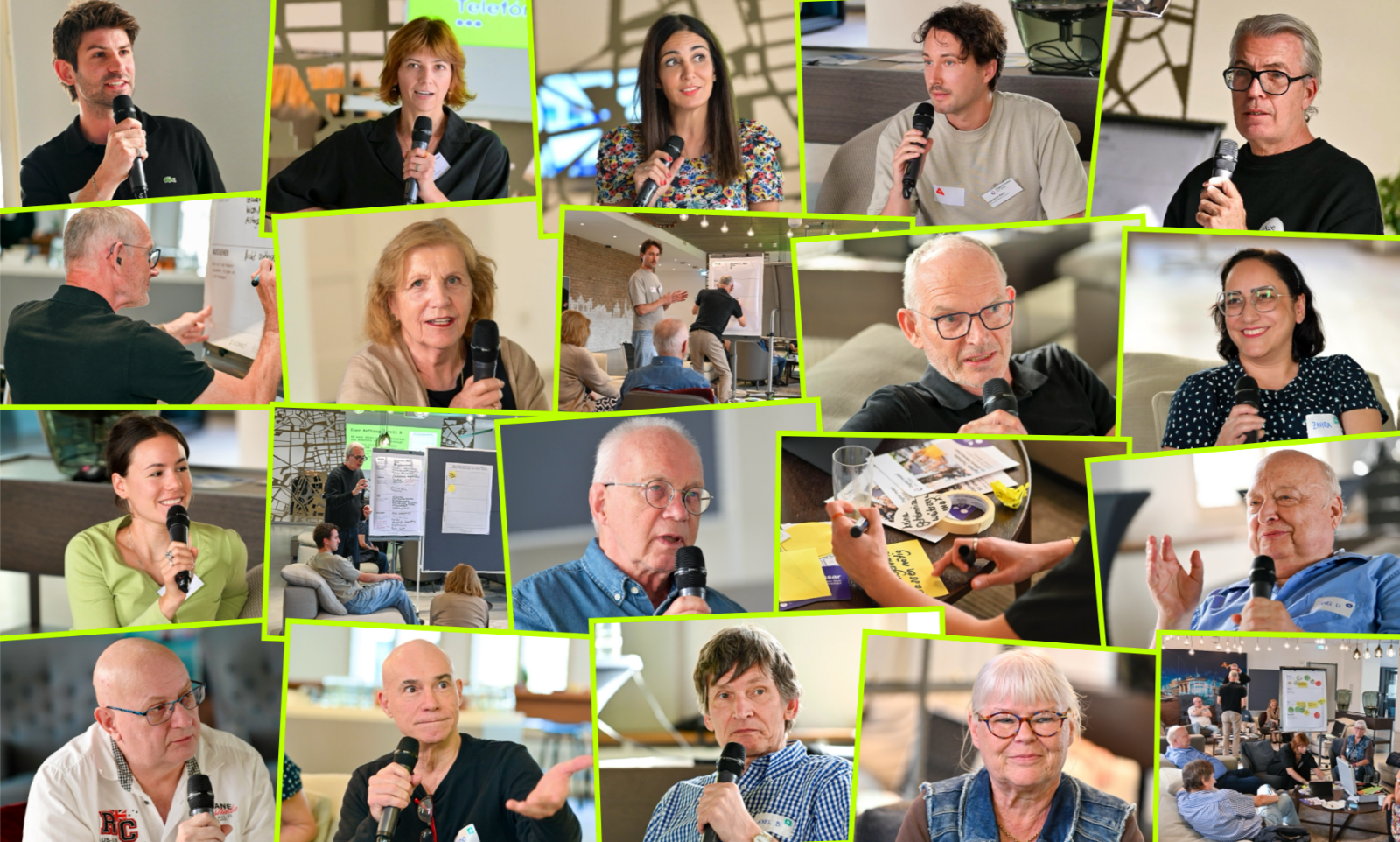
A total of 15 people took part in the first Age Forward Lab Sprint. Participants were recruited through channels including social media and Stiftung Digitale Chancen’s WhatsApp channel. Foundation staff also joined the group work, bringing younger and older participants’ perspectives into both groups. The participants were not intended to form a representative sample. The aim was to explore different ideas, needs, and boundaries through active participation.
The session opened with a brief introduction to robotics. We started with the images shaped by decades of comics, movies, and pop culture: robots as helpers, threats, machines, or almost human companions. From there, we explored robotics today and how much of what once seemed like fantasy is now technically possible.
Next came “From tool to social partner,” a brief talk drawing on the psychology of aging. It explored key aspects of human-robot interaction: appearance, social cues, movement and use of space, voice and conversation, and a system’s ability to respond and adapt to people and situations.
Participants then worked in two groups to imagine their own robotic companion. First, they mapped out the qualities they wanted across four dimensions: “Knowing,” “Feeling,” “Doing,” and “Appearance.” Next, they considered those qualities across stages of life from roughly age 20 to 80, discussing when and under what circumstances each might become more or less relevant.
The qualitative analysis drew on the groups’ flipcharts and presentations, supplemented by observations, handwritten notes, and selected comments from the discussions. Across both groups, we identified recurring needs, boundaries, tensions, and ideas about how a robot’s role might change over the course of a person’s life.
The four dimensions:
“Knowing,” “Feeling,” “Doing” & “Appearance”
One thing stood out during the group work: Both groups started with “Doing.” It seemed easier to begin by listing tasks. Cleaning. Sharing information. Giving reminders. Offering advice. Entertaining. From there, the other dimensions came into play.
Doing: Freeing up time, opening up possibilities
The task lists covered a lot of ground: laundry, cooking, cleaning, and washing dishes. They also included admin tasks, reminders, smart home features, help making sense of information, preventive health, and guidance on nutrition and finances. Language learning and entertainment through playing the violin together made the list, too.
What stood out was how naturally participants saw support extending well beyond traditional care needs.
Dr. Tim Kuball explained: “The SOC model provides a useful framework here (1). Selection, optimization, and compensation describe how people choose goals, use their resources, and adapt to change. A robot can support these processes in different ways. Which function is useful at any given time depends on a person’s goals, capabilities, and circumstances.”
The same robot could help the household run more smoothly at one stage of life, support learning at another, and later compensate for physical limitations, perhaps taking over certain tasks. Its role would need to be reassessed as life changes.
Knowing: Personal, with boundaries
Both groups wanted a robot that knows the people it lives with. A shared language and relevant information about their circumstances, interests, life stories, values, or health can help tailor its support to them.
Participants also set clear boundaries. Robin should only know what’s truly necessary and explicitly shared with permission. Its information should be up to date, verified, and reliable. Hallucinations and fake news were explicitly ruled out.
Nobody was envisioned more as a long-term companion. It could know and take into account a person’s life story, values, and changing circumstances. The groups had different views on how much knowledge would be helpful. They largely agreed on who should control it.
Feeling: Closeness needs an off switch
Both groups valued empathy, honesty, understanding, and support. A robot should be able to disagree and give honest feedback. Simply agreeing clearly wasn’t enough to make it a good companion. Manipulation and paternalistic behavior were seen as crossing a line and firmly ruled out.
The Robin group summed up who should be in control in one sentence:
“We want to stay in control. We’re the boss.”
The discussion also brought up a desire for an “emotional brake”:
“We need to always know it’s not human.”
That presents a real design challenge. A robot can respond with empathy, remember things, and perhaps offer comfort. At the same time, it should remain clearly recognizable as a machine.
Feeling and appearance are closely connected here. Voice, movement, gaze, and other social cues can create a sense of closeness. As with another person, this brings expectations of understanding, reliability, and connection. Robot design needs to account for those expectations. What the groups wanted was a robot whose social cues are easy to read and whose artificial nature remains clear: Interacting with it should feel intuitive. It should still look like a machine.
Appearance: A companion with its own character
Both groups deliberately chose to move away from humanlike robot designs.
Robin was given a telescoping arm, eyes suggested by light, a surface that feels pleasant to the touch, and a compact form.
Nobody has arms, legs, and hands. Its screen face still makes it clearly recognizable as a machine. Its design should adapt to different uses and situations.
The designs show that neither group saw a humanlike appearance as essential to feeling close to a robot. A robot can have a form of its own and still be easy to understand and interact with.
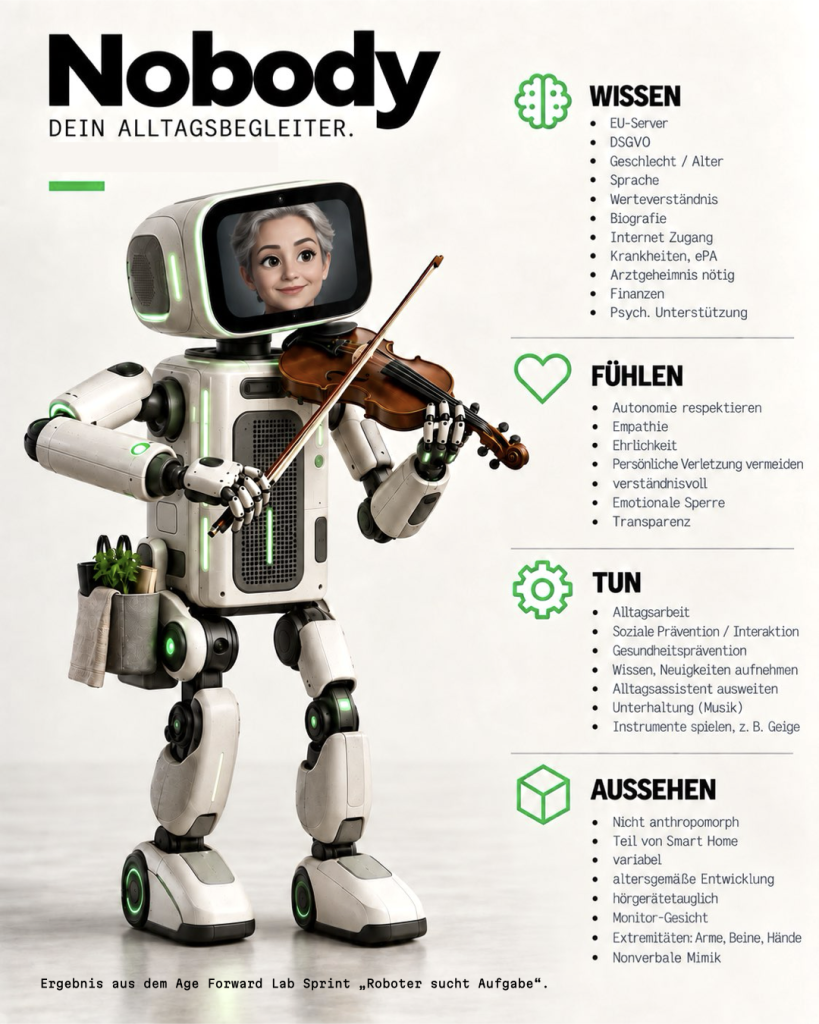
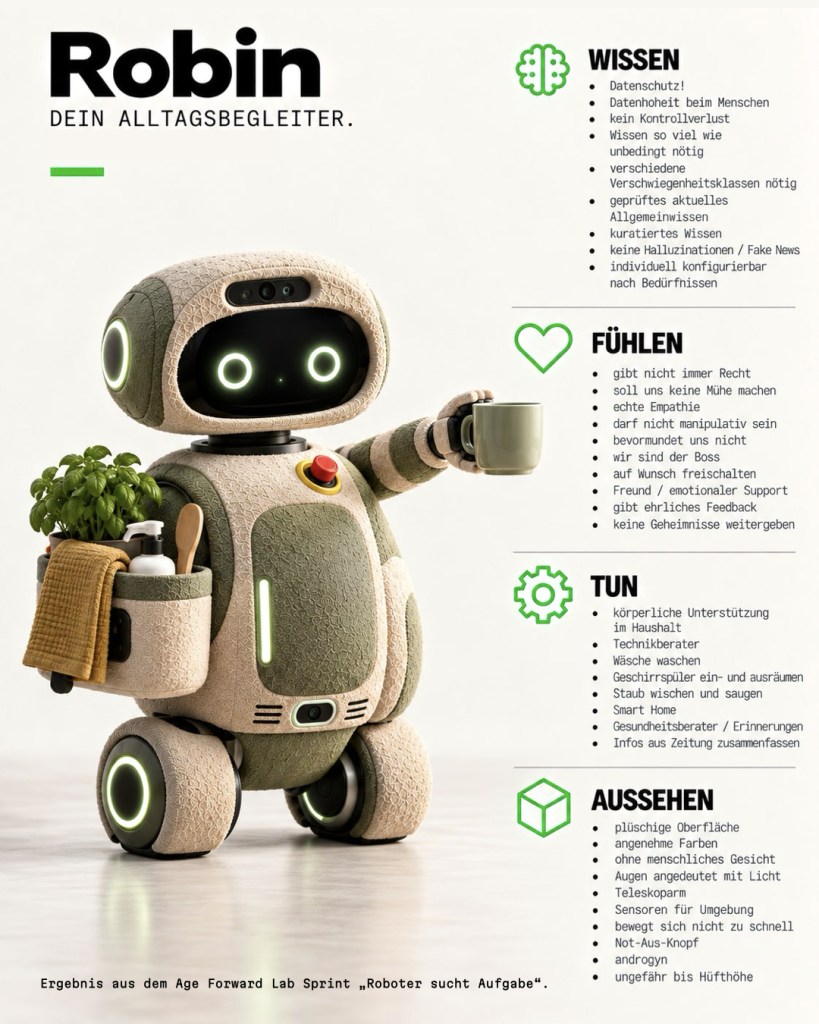
The two robot images are AI-generated interpretations of the workshop results. They bring the groups’ ideas to life and give us something concrete to build the conversation around.
Nobody and Robin: Closeness on your terms
Nobody is envisioned more as a companion that evolves with you throughout life. It knows your circumstances, life story, and values, connects with other systems, and can change over time. The group even considered what happens after death: What becomes of the information it has stored about me? Delete it? Keep it? Leave a digital legacy?
Robin was given clearer boundaries: minimal data, explicit permissions, an emergency stop button, verifiable knowledge, and visible human control. It can still be warm, empathetic, and pleasant to the touch.
Both designs lead to the same design question: How much closeness, knowledge, and autonomy should an assistive system have? And who gets to decide?
Both groups were clear: The decision must rest with the people who live with the robot.
As life changes, so do our needs
In the second part of the workshop, we took the designs through different stages of life. The groups explored how the relevance of specific tasks and features might change along the way. No simple pattern emerged in which getting older automatically meant needing more support.
Control over personal data, transparency, reliable information, and autonomy remained important across much of the lifespan. Other functions became more or less relevant as daily life changed. Help around the house can be just as valuable when time is tight as it is later, when physical abilities change. Emotional support might matter more during loneliness, stress, or life transitions. Health information can take center stage for a while, then recede. Learning remains possible throughout life.
Dr. Tim Kuball: “Lifespan psychology sees development as lifelong, multidimensional, and multidirectional, with gains and losses occurring together (2). People’s abilities and skills, as well as their goals and needs, can change in different, highly individual ways. Biological, social, and biographical influences always interact. That’s why people of the same age may need very different kinds of support.”
For designers, that means a birth year isn’t enough of a brief. What matters is how someone lives, what matters to them right now, and what support they actually want.
So the key question is: What does this person need in this situation, at this stage of life, with these capabilities and limitations?
“Evolving with us” took on another meaning during the discussion. One participant said:
“Today’s spare parts won’t be available tomorrow.”
A companion built for decades would need the technology to last, too: repairable, updatable, modular, and as independent as possible from short product cycles. A robot designed to stay with us throughout life needs a plan for its own aging.
What this means for robotics
Two groups can’t give us a universal blueprint. But their designs offer concrete clues about the questions that belong in development and design.
An assistive system should be useful early on and adaptable later. It should offer support without imposing it. Use information with permission. Allow for different levels of emotional and physical closeness. Make its decisions easy to understand. And accept that something helpful today may be unnecessary or unwanted tomorrow.
For AgeTech, that means designing for learning, joy, relief from everyday demands, social participation, and room to live freely, alongside compensating for limitations.
Dr. Tim Kuball: “The Technology Acceptance Model (3) identifies perceived usefulness and perceived ease of use as important factors in technology acceptance. For a social companion, it’s also worth considering trust, control, and how well it fits into someone’s life. In the sprint, these questions became very concrete: What can the robot know about me? Where do I draw the line? And can I change its role?”
The sprint put these questions on the table. Along with boundaries, contradictions, and very specific wishes.
What we’re left with is a pretty simple requirement: Good technology needs to adapt as our lives change. And it needs to let us decide what role it plays and how close we want it to get.
Thank you!
Thank you to everyone who joined in, pushed the thinking further, and shared their ideas. And to Laura Hänsch, Matthias Röck, and Juliane Reinecke from Stiftung Digitale Chancen, as well as Deniz Taskiran from Telefónica Germany, for their input and the great space.
On November 5, we’re back with the next Age Forward Lab Sprint: “Community seeks connection.”
We’ll explore a digital community that can evolve as our lives change. What do we need to participate and feel we belong? What would we let a tool like this know about us? What do we want to control ourselves? And how can it build on existing connections as our circumstances change?
On December 10, the third and final workshop of the year follows: “Home seeks room to grow.” How can we design a home from the start so it can adapt as our lives change? And how can it stay open to new needs and different ways of living together?
Find out more here: Digital mobil im Alter
What assumptions about age are built into your products and services?
Assumptions about age are often already shaping a product, service, or idea while it’s still taking shape. In our Age Forward Lab Sprints, we make those assumptions visible, bring together people with different lived experiences, and turn their perspectives into new possibilities.
Ready to explore this with your team or organization? Let’s talk.
Book a free, no-obligation video call!
Sources:
(1) Freund & Baltes (2002)
(2) Baltes (1987)
(3) Davis & Granić (2024)

